
VA Budget Cuts and Workforce Reductions: What’s at Stake for Veterans’ Health
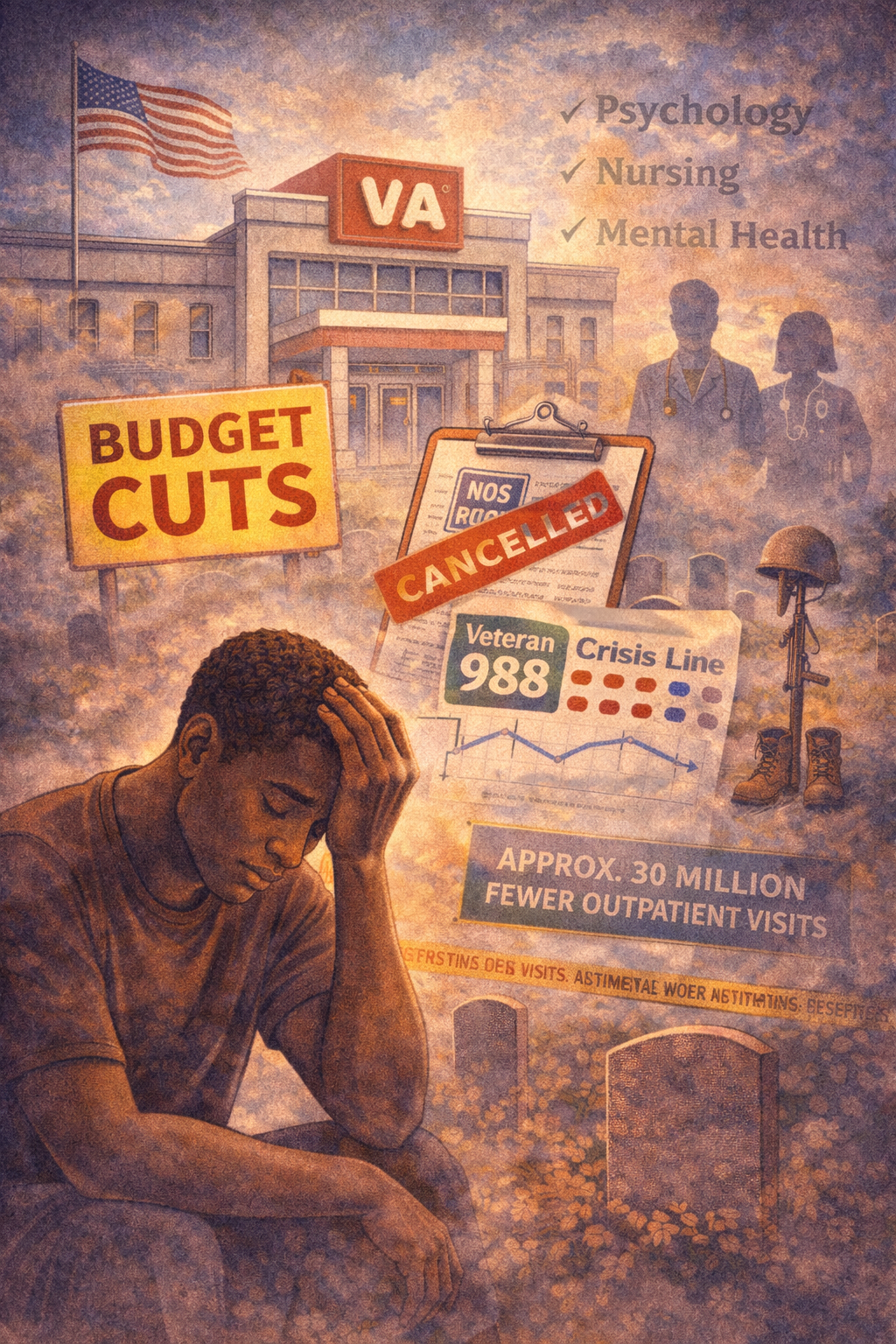
Veterans’ health care is not just another line item in a federal budget. For millions of Americans who served, the Department of Veterans Affairs (VA) is the primary source of medical care, mental health treatment, and suicide prevention support.
Recent proposals involving hiring freezes, workforce reductions targeting more than 80,000 positions, and broader budget constraints have raised serious concerns among veterans, clinicians, and policymakers about access to care and suicide prevention capacity.
The question is not political. It is practical: What happens to veterans when the system designed to serve them shrinks?
The Mental Health Pressure Point
Veteran suicide remains one of the most urgent public-health challenges in the country. Approximately 6,400 veterans die by suicide each year — a rate significantly higher than that of the general population.
Mental health and substance-use services are core components of suicide prevention. Yet staffing reductions and hiring pauses are reportedly affecting precisely those specialties:
Mental health clinicians
Substance abuse treatment staff
Suicide prevention coordinators
Veterans Crisis Line personnel
When staffing drops in these areas, wait times rise. Reports indicate that more than one-third of VA facilities have new mental-health patient wait times exceeding 40 days. For someone in crisis, a delay of weeks can be the difference between stabilization and escalation.
The Veterans Crisis Line, which provides immediate intervention, depends heavily on trained responders. Any reduction in staffing or funding capacity risks creating bottlenecks at the front door of care.
Staffing Shortages Were Already Severe
Even before recent cuts, the VA faced workforce gaps. Nearly all VA health centers reported shortages in key positions such as nursing and psychology.
Hiring freezes and workforce reductions on top of existing vacancy rates compound strain. Remaining staff report:
Increased caseloads
Burnout
Uncertainty about job stability
Lower morale
When morale drops, retention suffers. When retention suffers, capacity shrinks further. It becomes a cycle.
One estimate suggests that proposed budget constraints could translate into tens of millions fewer outpatient visits — a significant reduction in available care nationwide.
Outsourcing: A Partial Solution with Limits
As VA staffing tightens, care is increasingly referred to community providers.
Community care can expand access — but it also presents challenges:
Many community providers lack training in military culture.
Suicide risk among veterans has distinct clinical patterns.
Continuity of care may suffer if coordination is weak.
Veterans often benefit from clinicians who understand combat exposure, military identity, and reintegration stress. That specialized knowledge matters in suicide prevention.
The Long-Term Health Impact
Workforce reductions do not only affect mental health. Chronic disease management, cancer treatment research, and complex care coordination may also be impacted.
Cancelled or delayed research initiatives can slow advances in veteran-specific treatments. Reduced staffing in specialty areas can limit timely care for chronic conditions that, if unmanaged, contribute to declining physical and mental health.
The Suicide Prevention Equation
Suicide prevention rests on three pillars:
Access
Timeliness
Trust
When wait times grow, when crisis services are strained, or when trusted clinicians leave the system, all three pillars weaken.
Veterans facing depression, PTSD, substance use, or economic stress need rapid entry into care — not structural barriers.
Efficiency vs. Access: The Balancing Act
Some reports suggest that critical positions are being exempted from freezes and that efforts are underway to improve efficiency within the VA system. Efficiency reforms are not inherently harmful; in fact, modernization is often necessary in large federal systems.
The concern arises when cost-cutting outpaces capacity planning.
In health care — particularly in suicide prevention — small reductions in access can have outsized consequences.
A Public Health Perspective
Veterans represent a population with elevated risk for suicide, chronic illness, and complex trauma exposure.
Policy decisions that affect staffing, crisis lines, and mental health infrastructure should be evaluated through a public-health lens:
Does this increase or decrease access?
Does this shorten or lengthen wait times?
Does this strengthen or weaken specialized care?
The stakes are measurable. Thousands of lives each year.
The Bottom Line for our Vets
Veterans were promised care in exchange for service. That promise is not symbolic — it is operational.
When staffing shrinks, wait times lengthen.
When wait times lengthen, risk increases.
When risk increases, prevention must be strengthened — not weakened.
If we are serious about reducing veteran suicide, protecting mental health infrastructure within the VA is not optional. It is foundational.